
prior authorization automation: chase the paperwork
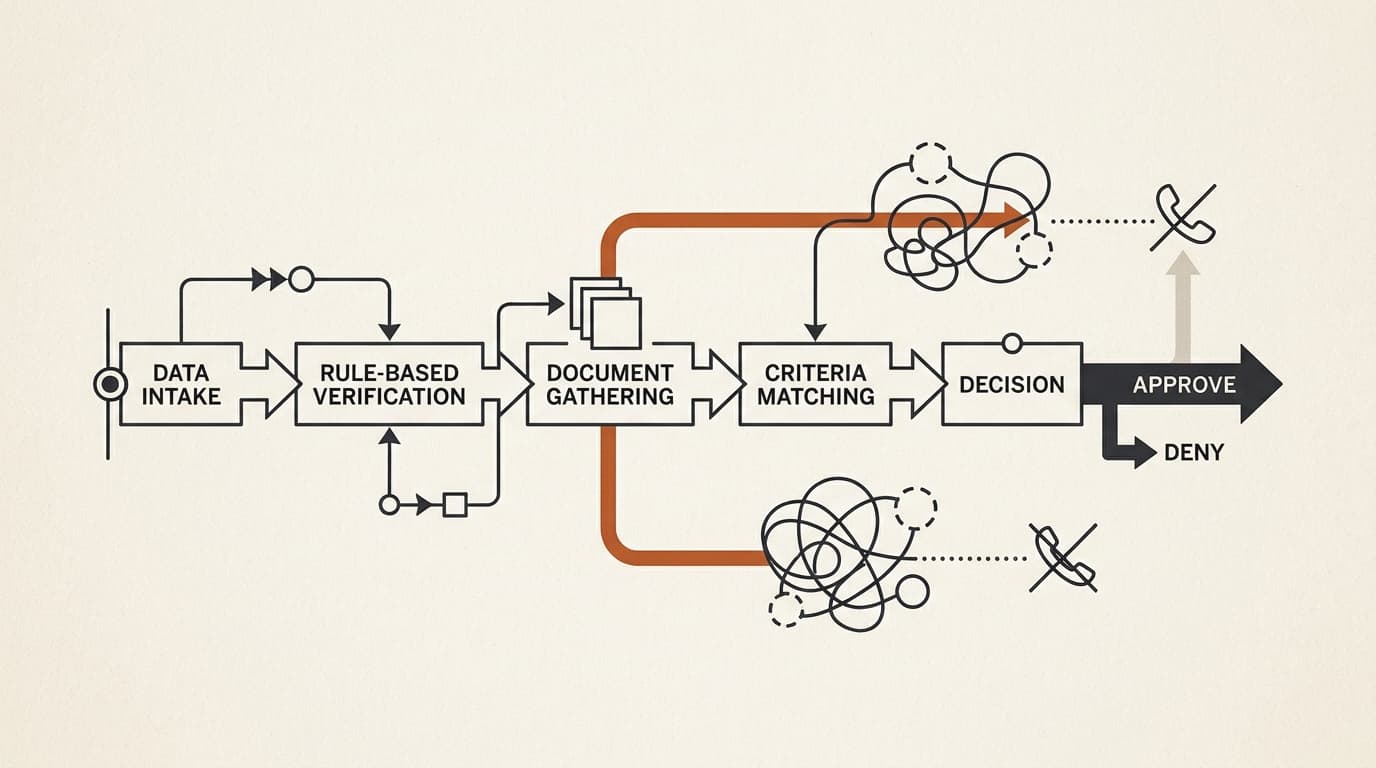
most vendors selling prior authorization automation are pitching an ai that handles the clinical review. that is both dangerous and beside the point. the delay in prior auth is almost never the clinical decision. a reviewer with the right chart in front of them can make that call in minutes. the delay is the four-day crawl before that: gathering the right records, matching them against a payer's checklist, confirming the cpt codes line up, and refreshing a portal to see if the request even registered.
automate that crawl and you have automated the thing that was actually broken. hand the clinical judgment to a model and you have built something that will eventually get a practice audited, or worse.
the paperwork queue is where authorization actually dies
walk through a denial and you rarely find a bad clinical call. you find a missing office note, a cpt code that does not match the diagnosis on file, or a packet that sat unsubmitted because someone was waiting on a fax confirmation that never came. the clinical standard the payer is applying is usually public and stable. what is not stable is whether the practice assembled the right evidence against it before the deadline.
this is coordinator work, and it is almost entirely administrative pattern-matching: pull the note, find the relevant section, check it against a list, confirm nothing is missing, submit, then watch a portal for a status change that could come in two days or two weeks. none of that requires clinical judgment. all of it requires attention, and attention is the resource a busy practice has the least of. the queue does not announce itself as broken. it just gets slower, case by case, until someone notices the backlog.
why handing clinical calls to a model fails
the instinct to fix this with a smarter model is understandable and wrong. a language model does not know when it is unsure. ask it whether a chart meets a payer's medical necessity criteria and it will answer with the same confidence whether the chart clearly meets the bar, clearly misses it, or is ambiguous in a way a human reviewer would flag for a second look. that confidence is the problem. a hallucinated citation to a clinical guideline, stated plainly, reads exactly like a correct one.
there is also a plain legal issue. a determination that affects patient care and gets submitted under a practice's name needs to trace back to someone licensed and accountable. a payer audit that finds an ai made the clinical call, with no human sign-off in the trail, is not a process failure a vendor can smooth over after the fact. the fix is architectural, not a better prompt: keep the model away from the decision entirely. it reads and organizes. it does not conclude.
how brittle rpa scripts break under portal updates
the other common fix is traditional rpa: a bot that logs into the payer portal, clicks through the same sequence of fields every time, and submits. this works right up until the portal changes a button position or adds a field, at which point the bot fails silently or loudly, and someone has to notice before the deadline passes. payer portals change often and without much notice, because that is not the payer's problem to manage for you.
the alternative practices fall back on is pure manual entry, which solves the brittleness problem by removing the automation altogether. that works, but it is the original bottleneck with a different name. coordinators burn hours on tasks that are repetitive but not yet reliably automatable, and the backlog returns the moment anyone is out sick or the volume ticks up.
extract, cross-reference, stage: the safe architecture
the pattern that holds up splits the work the same way i split it everywhere else in regulated work: a model reads, a deterministic function decides, a human signs off.
the model's job is narrow. it parses the clinical notes and pulls out the structured facts a payer's checklist actually asks for: diagnosis codes, relevant procedure history, dates, the specific clinical findings a payer lists as required documentation. that gets written out as structured data, not a judgment, not a recommendation to approve or deny.
that structured data then goes through a deterministic validator, plain code with no model in the loop, that checks it against the payer's published criteria line by line. does the diagnosis code match what the procedure requires. is the documentation the payer asks for actually present. are there gaps: a missing note, a code that does not reconcile. the validator cannot be talked into a result. it either finds what the rule requires or it flags the gap.
only after that does a person enter the loop, reviewing a packet that is already assembled and already checked, making the actual clinical and submission call, and signing off before anything goes to the payer. the model did the reading. the code did the checking. the human made the decision. that is the whole architecture, and it is why each step can be inspected afterward instead of trusted on faith.
if you want to see where your own authorization queue breaks down before committing to a build, the Workflow Audit is a two-week, fixed-scope diagnostic that maps the actual bottlenecks in your process, not a generic one, and the fee is credited toward a build if you move forward.
audit trails and graceful human fallback
every packet the system assembles gets logged: what the model extracted, what the validator checked and flagged, and what the human approved, timestamped and stored in the practice's own infrastructure, not mine. if a payer later questions a submission, the trail is there to read line by line, not reconstructed from memory.
the harder cases are the honest test of a system like this. if a required note is missing, or a code cannot be reconciled with the diagnosis, the system does not guess and it does not quietly approve a thin packet to keep the queue moving. it routes the case to a coordinator with the gap clearly marked, and it waits. the same applies if the model itself is unavailable for some reason: the case does not get stuck in a void, it drops to a human queue, because the one thing worse than a slow authorization is a wrong one that nobody can explain.
if your practice is still measuring prior auth delay in days lost to the portal rather than days spent on clinical review, that is the gap worth closing first, and it is worth closing with a system you can audit rather than one you have to trust.