
legal document automation: draft the paperwork, keep the judgment
a junior associate sits with twenty medical records, a discovery request, and four hours to assemble a standard disclosure packet. rush it, and they miss an exclusion. hand it to a raw language model, and it fabricates an exhibit number that looks exactly as confident as the real ones. neither failure shows up until someone downstream relies on the document.
this is the actual question behind legal document automation: not whether a model can write legal text, but whether anything in the pipeline is checking what it wrote before a human signs their name to it. most tools skip that question. that is the whole problem.
the illusion of end-to-end drafting
the pitch for most document automation for law firms is that you feed in case facts and get back a finished instrument. a demurrer, a disclosure, a settlement letter. the model does the reading and the writing in one pass, and the output looks like something a senior associate would produce.
the trouble is that looking right and being right are different properties, and a language model is optimized for the first one. it will produce a fluent packet with a clause that does not match this jurisdiction's rule, or an exhibit reference that does not exist in the case file, because fluency does not require the number to be real. it only requires the sentence to read like one that would contain a real number.
firms that have been burned by this usually respond by adding a review step at the end: a partner reads the whole draft before it goes out. that works, but it defeats the purpose. if a human has to re-verify every fact in a fully-drafted document, the automation has not removed the bottleneck. it has just moved it and added a layer of false confidence in between.
where the breakdown actually happens
the failure is not really in the drafting. it is upstream, in extraction, and it is silent because extraction errors inherit the same fluent tone as everything else the model writes.
ask a model to read twenty medical records and pull the relevant diagnoses, dates, and provider names, and it will do that well most of the time. but "most of the time" is not a standard that survives contact with a filing deadline or a bar complaint. when the model misreads a date or merges two providers into one, nothing flags it. the output still looks like a clean table of extracted facts. it just has one wrong row, and that row goes straight into the next document with no checkpoint in between.
the same thing happens with indexing. a discovery packet with forty exhibits needs stable numbering that matches the exhibit list, the pleadings, and the physical files. a model asked to both extract the exhibits and number them is making a structural decision alongside a reading task, and structural decisions are exactly where it should not have the final word. one dropped exhibit, one renumbering on a re-run, and the index no longer matches the file.
none of this throws an error. the document generates, the packet looks complete, and the only place the mistake shows up is in a courtroom or a client's hands, much later.
the split between parsing and assembly
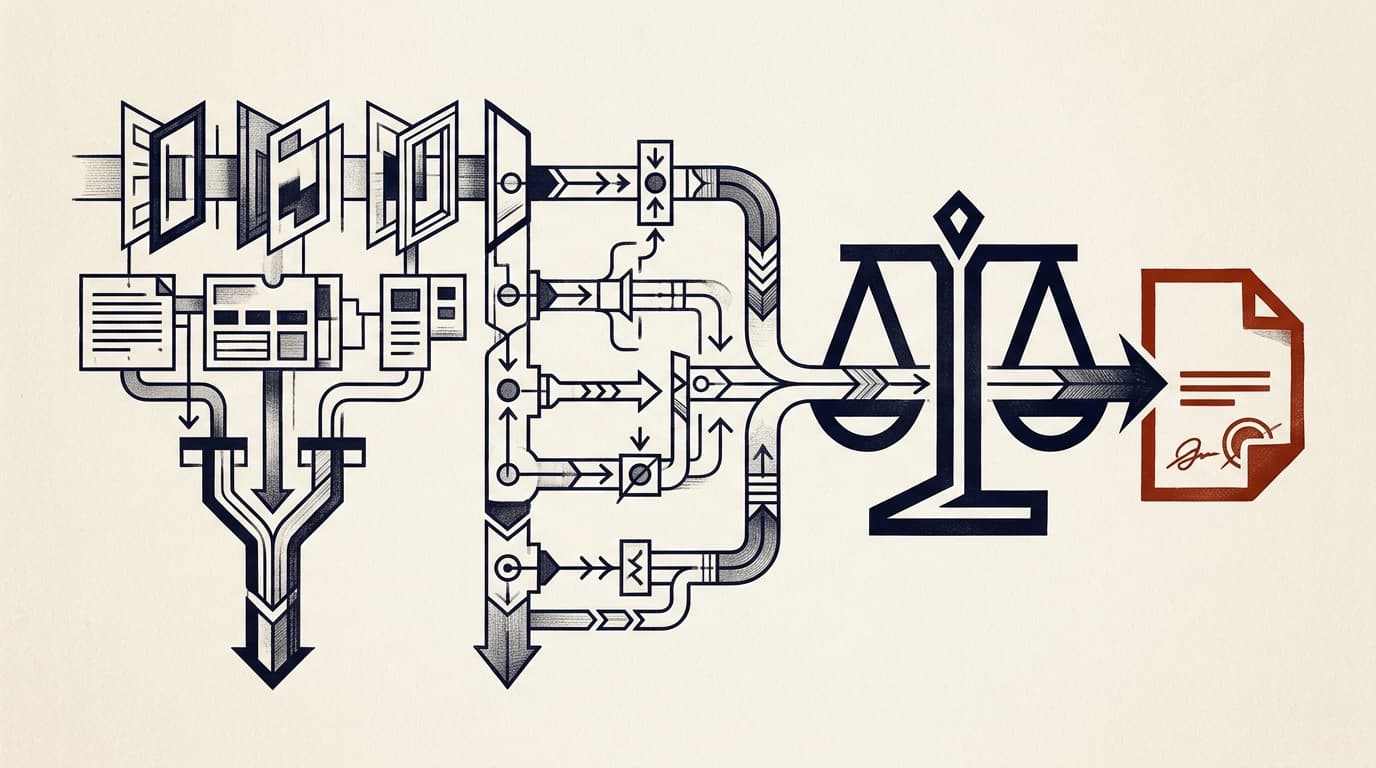
the fix is to stop asking one system to both read and decide. the model's job is extraction: pull facts out of unstructured records and hand them over as structured data. it never touches the template, the clause selection, or the final document. a separate, deterministic function, ordinary code with no model in the loop, takes that structured data and checks it against static rules before anything gets assembled: does this exhibit number already exist, does this clause apply in this jurisdiction, does this field match the format the template expects.
only after that validation passes does the document get assembled, and assembly itself is template rendering, not generation. the model never writes the operative language of the instrument. it extracts; the deterministic layer decides what to do with what it extracted. that split is what makes the output auditable. you can trace a single field in a finished document back through the rule that approved it to the exact source record the model read, line by line, without having to re-read the model's reasoning to understand why a number is what it is.
this is also why the split matters more in regulated work than anywhere else. a marketing draft that is slightly wrong costs you a rewrite. a legal document that is slightly wrong, with a fabricated reference or a misapplied exclusion, costs something that does not undo with a rewrite.
a human gate that leaves a paper trail
even with validated extraction, nothing gets filed, sent, or added to a case file without a staged step first. the system writes the proposed document and stops. it does not commit anywhere until someone with authority over the file explicitly approves it. that approval is not a formality, it is the point at which a person with case knowledge looks at structured output that has already passed rule checks, which is a much smaller task than proofreading a full draft from scratch.
before that approval, the proposed document is checked against the existing case file: do the parties match, does the exhibit numbering conflict with anything already filed, does the extracted data line up with what is already on record. a document that would conflict with existing filings does not get queued for approval. it gets flagged instead.
every one of those steps, extraction, rule validation, staging, approval, leaves a record. if a document's provenance is ever questioned, you can show exactly what was read, what rule approved which clause, and who signed off, rather than asking everyone to trust that the model got it right.
[[FIGURE:1]]
what this looks like in production
- extract, don't draft. the model reads source records, medical files, intake forms, prior filings, and outputs structured fields: dates, parties, diagnoses, exhibit references. it writes no operative legal language at this stage.
- validate against static rules. deterministic code checks the extracted fields against jurisdiction rules, template requirements, and the existing case file. anything that fails validation is flagged, not silently corrected.
- stage the assembled document as a dry run. the template renders with the validated fields, but nothing is filed, sent, or saved as final. it sits in a queue.
- run a conflict check against the case file. exhibit numbers, party names, and dates are compared against everything already on record for that matter. a conflict blocks the document, it does not pause it with a suggestion.
- route to a human for explicit approval. someone with authority over the file reviews the staged document and either approves or sends it back. approval is logged with a timestamp and the reviewer's name.
- commit and record provenance. only after approval does the document become final, and the full trail, source records, rule checks, reviewer, is kept with the file.
if you are trying to figure out where your own intake and drafting process would need this kind of gate, that mapping work is the first step, before any automation touches a live file. the Workflow Audit is a two-week engagement, priced at $2,500 and credited toward a build, that maps document intake rules and decision points so the deterministic layer gets built around how your practice actually works, not around a demo.